
You're not lazy. You might be in functional freeze.
Feeling lazy and broken but somehow still functioning? It might not be laziness. It might be functional freeze, and there's a small daily way out.



On this page
You sit down to write the email. You have written it ten times in your head. The cursor blinks in an empty compose window for forty minutes, and then you quietly close the laptop.
You are not depressed. You are not burnt out in the dramatic way, no breakdown, no crying in parking lots. From the outside, everything is fine. Your friends would say you have it all together. Your boss thinks you are crushing it. Your family hasn’t noticed.
But internally, you have been off for a while. Months, maybe years. You watch yourself live your own life from about three feet behind your eyes. You go through the motions. You hit the deadlines. You answer the texts, eventually. And underneath all of it, something is just not running.
If any of that lands, what you are describing might not be laziness. It might be functional freeze.
What is functional freeze?
Functional freeze is a state where your nervous system has dropped into a low-grade shutdown, a kind of survival response, but you have gotten so good at performing competence on top of it that almost no one can tell. Your body has registered, somewhere, that the cost of pushing through keeps climbing. So it pulls back. Quietly. Underneath the surface, where you can still get the laundry done.
The technical version of this involves words like dorsal vagal, autonomic shutdown, neuroception of threat. You do not need any of that to recognise it. This is a nervous-system state, which is why the wider picture lives on our main guide to functional freeze.
Functional freeze is a lesser-known stress response that falls under the umbrella of the fight-flight-freeze survival mechanism.
If you want it explained out loud before reading on, this short video walks through what the functional freeze response is and why it is a nervous-system state, not a character flaw.
Functional freeze symptoms
The symptoms are simpler than the theory:
- You sit down to start something you actually care about and you cannot begin.
- The to-do list keeps growing. The cross-offs do not.
- You feel weirdly numb, not sad, not happy, just flat. Watching from behind glass. That flat, muffled feeling has its own name: emotional numbness.
- Decisions that should be small feel impossible. What’s for dinner. What to wear. Which email to answer first.
- You are tired in a way that sleep doesn’t fix.
- You self-diagnose as lazy. Or broken. Or “just tired.” None of those frames fit, but you keep using them because you do not have a better word.
You probably also do a lot of things competently. Show up. Hit your targets. Hold relationships together on the surface. Maintain.
That is the part that makes functional freeze so quietly insidious. It hides behind capability. The more high-functioning you are, the longer it gets to run before anyone, including you, takes it seriously.

Functional freeze vs laziness, depression, and burnout
It isn’t laziness. This is the frame most people in functional freeze use against themselves, and it is the most damaging one. Laziness is when you do not want to do the thing. Functional freeze is when you cannot make your body do the thing. They look the same from the outside. They are not the same on the inside.
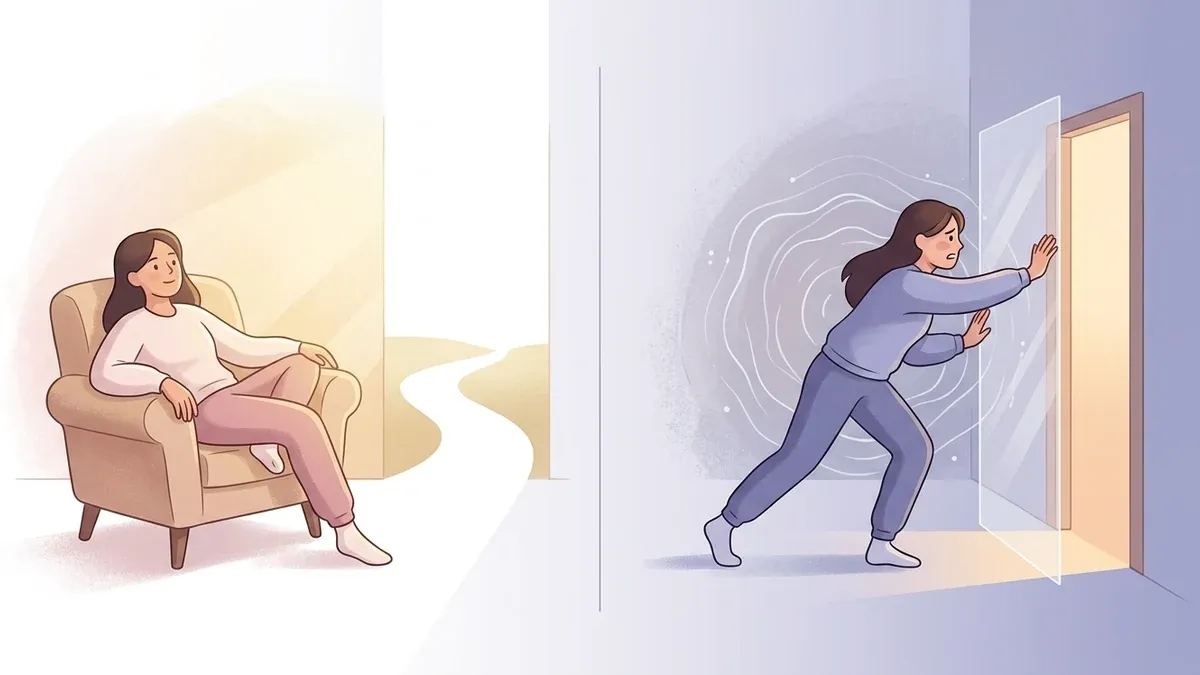
It isn’t depression, exactly. The depression frame does not quite fit. Depression carries a kind of weight to it; functional freeze has a quietness. There is no sadness, no despair, just an off-ness. A flatness. The lights are not out, they are on a dimmer. Most people in functional freeze have already quietly rejected the depression label, which is part of why the medication route a friend swears by has never appealed.
It isn’t burnout, technically, though they overlap. Burnout is what happens when the load is currently exceeding your capacity. Functional freeze is what your body learned to do because the load exceeded your capacity for too long, and now the shutdown has become the default operating mode even when the load eases. You can be in functional freeze on a Saturday with nothing on your plate.
It isn’t a personality. It is a state. That distinction matters more than almost anything else here, because you have not been “this kind of person” the whole time. States change. That is the entire point.
How to know if you’re in functional freeze
There is no clinical test. But the recognition usually goes something like this.
You are scrolling, and a creator on TikTok or a Substack writer drops the phrase functional freeze. You read the description. Halfway through, you have the feeling of being seen for the first time in a long time. Finally, a name for this. You scroll the comments. Other people are saying the same thing. I thought it was just me.
That is the discovery moment, and it is a strangely common one. People remember exactly where they were when they found the term. If you are having something like that moment right now, the answer is probably yes.
What helps you get out of functional freeze
Things that tend not to work:
- More productivity systems. Notion, Sunsama, Pomodoro, dopamine detoxes. They all assume you can start. The whole problem is that you cannot.
- Bigger interventions. Retreats, weekend programs, intense fasts, ten-day silent meditations. A system already in shutdown reads “big” as “more threat” and shuts down further.
- Pure talk therapy, on its own. It can be enormously useful, and many people in functional freeze have done years of it. It is the right tool for understanding the freeze. Understanding cognitively that you are in freeze does not, by itself, unfreeze you.
- “Just push through.” Push-through is part of what put you here. The way out is down, not harder.
Things that do tend to work:
- Small. Very small. Smaller than you think it should be. Not a thirty-minute morning routine, a sixty-second nervous-system interrupt. Not “go for a run,” but “stand up.” The system accepts tiny inputs and rejects big ones.
- Daily. The compounding is in the dailyness. One sixty-second move every day for two months moves far more than two hours of effort once a month.
- Body first, then behaviour. The freeze lives below language, so the first move is physical. The behavioural move comes after, and lands more easily once the body has settled. This is the ground covered in nervous system regulation.
- Structured. Deciding is the part that does not work in functional freeze. What helps is having today’s small move already chosen for you. The structure is the medicine.
For a set of concrete small moves in this same register, these polyvagal-based micro habits for escaping the freeze response line up closely with the small-and-daily approach above.
Where Tuun comes in
Tuun is built around exactly that. A daily card, five to seven minutes, calibrated to where you actually are. One small body-based move, one small action, designed for the moment you cannot start. Built so that, on the days nothing else moves, this one thing still does.
If any of this sounded like you, the two-minute quiz is the next step. It reads where you actually are and builds a plan from there. If you live with ADHD, the overlap is worth reading too: functional freeze and ADHD.
You are not lazy. You might be frozen. There is a name for it, and there is a way back.
Sources
- Kohls, C.. (n.d.). What is functional freeze? Symptoms, differences from depression & how to cope. LifeStance Health.
- Health. (n.d.). What is functional freeze?. Health.com.
- Banner Health. (n.d.). Functional freeze mode: what it is and how to break free. Banner Health.
- Therapy in ACTion. (n.d.). What is the functional freeze response, and how to break free [Video]. YouTube.
- McAdam, E. (Therapy in a Nutshell). (n.d.). 7 micro habits to escape the freeze response [Video]. YouTube.
Tuun is a wellbeing product, not medical care. If you are in crisis, please contact 988 (US/Canada), Samaritans 116 123 (UK & IE), Lifeline 13 11 14 (AU), or your local emergency services. See our full wellness disclaimer.