
Somatic exercises: what they are, and how to actually start
Somatic exercises are small, body-first movements that signal safety to a stressed nervous system. Here's how they work, a beginner sequence, and how often to do them.



On this page
Somatic exercises are small, body-first practices, slow breaths, gentle movement, touch, and attention to physical sensation, that help shift your nervous system out of a stress state and back toward calm. Instead of talking or thinking your way to feeling better, you work from the body up: you give your system the physical signals of safety it responds to, and let the calmer state follow. “Somatic” just means of the body.
That is the whole idea, and it is quieter than the wellness internet makes it sound. You don’t need a mat, an hour, or a special routine. Most of these are things you can do sitting in a chair, in under a minute, without anyone knowing. What makes them work isn’t intensity. It’s that they speak the language your nervous system actually listens to.
What are somatic exercises?
A somatic exercise is any small practice that uses the body, movement, breath, touch, or sensation, to change how your nervous system is doing, rather than what you are thinking. The word covers a wide range: slow exhales, gentle stretching and shaking, orienting your eyes around the room, pressing your feet into the floor, humming, a hand on your chest. What they share is the direction of travel. They start in the body and let the mind catch up, not the other way around.
This is different from most advice you have been given. “Reframe the thought,” “challenge the belief,” “just relax” all start in the mind and hope the body follows. Somatic work flips that. It assumes the part of you that is wired, frozen, or flat doesn’t take verbal instructions, so you reach it through signals it can feel instead.
How do somatic exercises work?
Your nervous system is always running a quiet background check: am I safe, or do I need to brace? When it senses threat, it shifts your body into a stress state, heart up, muscles tight, attention narrow, or, after a long enough stretch, into the flat, shut-down version of that. The trouble is that the system can get stuck on “brace” long after the actual stress has passed, which is what living in a dysregulated nervous system feels like.
Here is the part that makes somatic exercises matter: that safety check responds to physical evidence, not arguments. A slow exhale, warmth, steady weight, something calm to rest your eyes on, these are signals the system reads as the emergency is over. You can fully understand that you are safe and stay braced anyway. But give the body the right small signal, repeatedly, and the state begins to soften on its own.
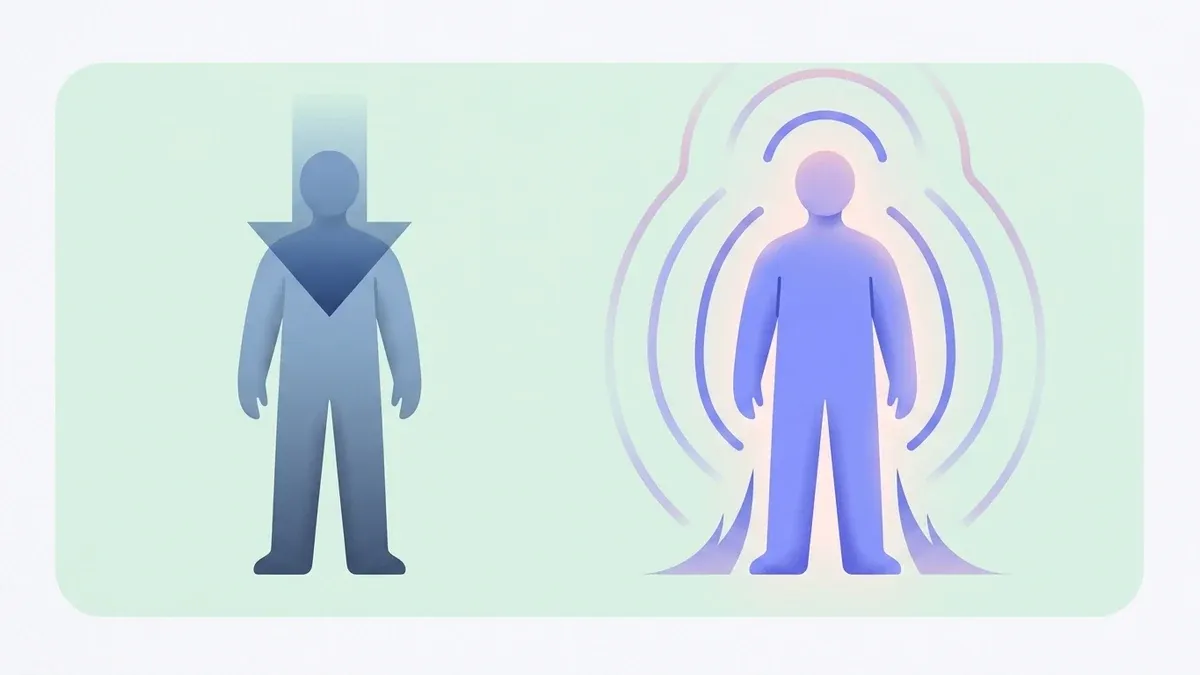
That bottom-up direction is why these small moves can do what willpower can’t. You are not overriding your nervous system or forcing calm on top of stress. You are giving the system the evidence it has been missing, so it has a reason to let go of the brace it has been holding.
Somatic exercises involve paying attention to internal sensations and responses during physical movements, harnessing the mind-body connection.
Somatic exercises for beginners: where to start
If you have never done this before, start absurdly small. A stuck nervous system reads “big” as “more threat,” so an intense new routine can backfire. Here is a short beginner sequence you can do in a chair, in about two minutes, eyes open or closed:
- Orient. Slowly turn your head and let your eyes wander around the room. Notice three things that are genuinely neutral or pleasant. This tells your system it can look up from the threat.
- Land. Press both feet flat into the floor and feel the ground push back. Let your weight settle into the chair. You are reminding the body it is supported.
- Exhale long. Breathe in for a normal count, then make the exhale slower and longer than the inhale. Do this three or four times. The long out-breath is one of the clearest “stand down” signals you have.
- Touch. Rest one hand on your chest or belly and just feel its warmth and weight for a few breaths. Steady, friendly pressure reads as safety.
- Notice. Before you move on, check whether anything is even slightly softer, the shoulders, the jaw, the breath. You are not chasing a big shift. A small one is the point.
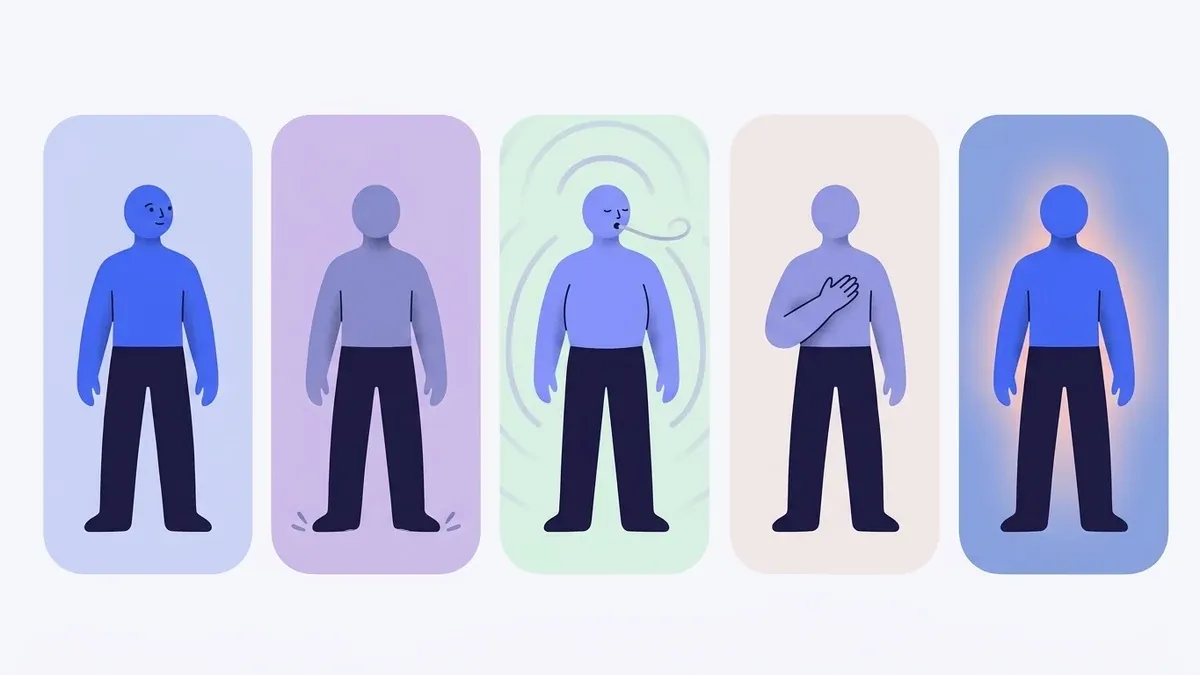
If even that feels like a lot on a hard day, do one step. One long exhale counts. The goal is not to complete a practice. It is to send the body a single honest signal, and to do that often enough that it adds up.
If you would rather be guided than read, this full-body somatic flow is a gentle place to practice the kind of slow, body-first movement described here. Press play when you have a few quiet minutes.
Somatic exercises for anxiety
When the stress is the wired, racing kind, anxiety, restlessness, a mind that won’t switch off, the helpful somatic moves are the ones that discharge and slow. Long exhales lengthen the out-breath that anxiety keeps clipping short. Gentle shaking or bouncing your legs lets the braced-up energy move instead of pooling. Orienting your eyes around the room interrupts the tunnel-vision that anxiety narrows you into. Humming or a quiet long sigh adds a slow, steadying vibration. The aim is not to force calm but to give the keyed-up system a way down.
Somatic exercises for trauma
When stress has older, deeper roots, the rule is gentler still: slower, smaller, and never pushing through. Trauma can live in the body as a freeze or shut-down state, the flat, numb, can’t-quite-start version covered in functional freeze, and big or fast practices can tip a guarded system further into overwhelm rather than out of it. Go for orienting, soft weighted touch, feeling your feet, and very small amounts of movement, always with the option to stop. If a practice makes you feel worse, more panicked, more dissociated, that is information, not failure: back off and make it smaller. For trauma specifically, doing this alongside a trained trauma-informed professional is worth more than doing it alone.
How often should you do somatic exercises?
A little, often, beats a lot, rarely. One small somatic exercise a day will shift your baseline far more than a long session once in a while, because you are slowly retraining a system, and systems learn through repetition. In the moment, a few slow exhales can take the edge off a spike within seconds. Changing the setting your whole system runs on is the longer project, usually weeks to months of small daily reps. The useful expectation is not “fixed by Friday” but “a little steadier each week.” This is the same small-and-daily logic behind a real nervous system reset: the dailiness is doing the work, not the intensity.
Where to start
You don’t need the full routine today. You need one small, body-first move you can make right now, a long exhale, your feet on the floor, a hand on your chest, and then the same kind of move tomorrow. It looks too simple to matter, which is exactly why it gets skipped.
If you would like a starting point chosen for you, calibrated to whether you are running wired, frozen, or flat, the two-minute quiz reads where you are and builds a daily plan from there: small enough to do on the days you can’t do much, regular enough to actually shift the setting.
Your nervous system isn’t working against you. It has been waiting for signals it can trust, and somatic exercises are simply how you start sending them.
Sources
- Salamon, M.. (n.d.). What are somatic workouts?. Harvard Health Publishing.
- Cleveland Clinic. (n.d.). Somatic exercises: What they are and how they benefit you. Cleveland Clinic Health Essentials.
- Johns Hopkins Medicine. (n.d.). Somatic self-care. Office of Well-Being.
- Brett Larkin Yoga. (n.d.). Somatic exercises to reduce cortisol & get out of freeze response [Video]. YouTube.
Tuun is a wellbeing product, not medical care. If you are in crisis, please contact 988 (US/Canada), Samaritans 116 123 (UK & IE), Lifeline 13 11 14 (AU), or your local emergency services. See our full wellness disclaimer.