
Understanding functional freeze

Functional freeze, explained.

Functional freeze is a quiet, low-grade shutdown of your nervous system. You keep functioning and look fine on the outside, but inside you feel flat, stuck, and numb. It's a state, not who you are, and it can change.

A woman sits paused at her desk amid softly floating to-do cards, a calm path opening toward warm light beside her.

What is functional freeze?

Functional freeze is a survival state where your body decides that pushing through costs too much, so it drops into a low-power, protective mode. The freeze is the shutdown. The functional part is that you've learned to perform over it, so almost no one notices. The work still gets done. Underneath, something just isn't running.

Also called a functional freeze state or freeze response, the experience is the same: present on the outside, frozen on the inside.

Signs and symptoms of functional freeze

Functional freeze hides behind capability, which is what makes it easy to miss. The most common signs:

  • You sit down to start something you care about and can't begin.
  • You feel numb and flat, watching your life from behind glass.
  • Small decisions feel impossible: what to eat, what to wear, which message to answer.
  • You're tired in a way that sleep doesn't fix.

The more high-functioning you are, the longer functional freeze runs before anyone, including you, takes it seriously.

Functional freeze vs. a normal off day

Everyone has flat days. A normal off day passes on its own; a good night's sleep or a free weekend resets it. Functional freeze doesn't. It's the default setting underneath your days, not a mood that visits one of them. You can have nothing on your plate and still feel unable to start.

It's worth separating from its neighbours. It isn't laziness: laziness is not wanting to, freeze is not being able to. It isn't quite depression, which carries a weight that the flat quietness of freeze doesn't. And it isn't burnout, though they overlap. Burnout is the load exceeding your capacity right now; functional freeze is what your body learned to do because the load exceeded it for too long.

Laziness is not wanting to. Functional freeze is wanting to, and not being able to make your body start.
Tuun
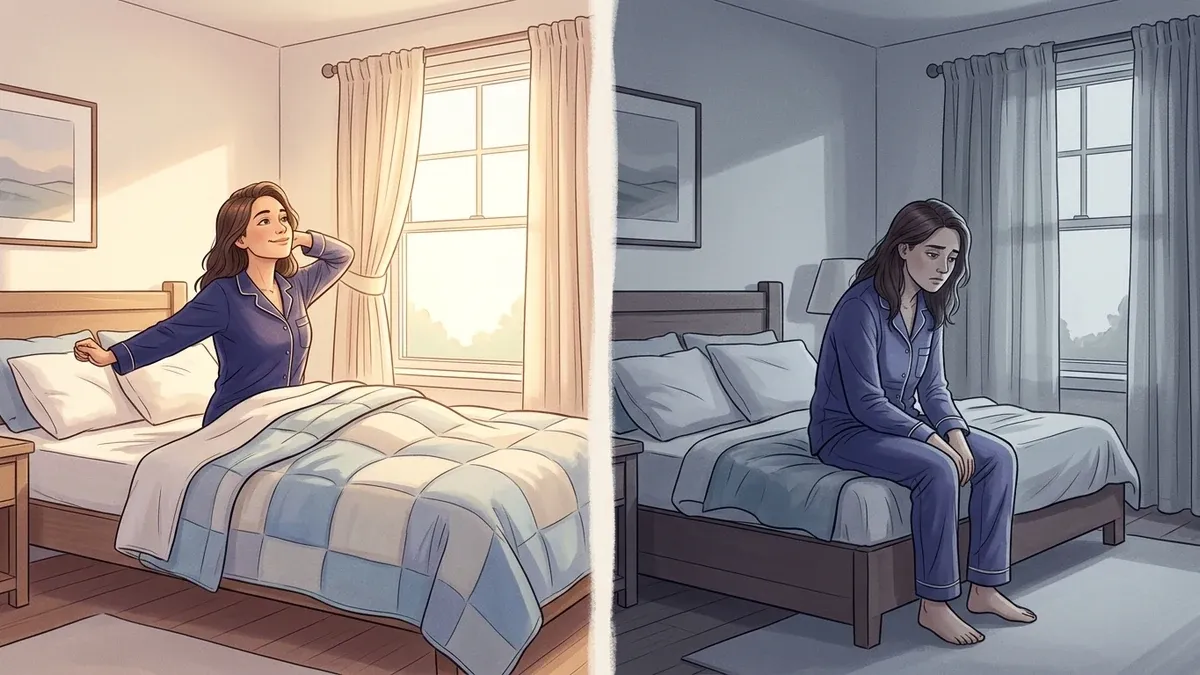
A two-panel illustration of the same woman in the same bedroom. On the left, bright morning light pours in as she sits up and stretches, rested after a normal off day. On the right, the room is dim and grey and she sits slumped on the edge of the bed, flat and unable to get going even after a full night's sleep, showing functional freeze that doesn't lift.
A normal off day dips and recovers on its own. Functional freeze drops and stays flat.

Why functional freeze happens

Functional freeze isn't a flaw in you. It's a protective response that built up over time. When the demands on your system stay higher than what you can discharge, through long stress, pressure to perform, or carrying more than you can put down, your body decides that pulling back is cheaper than pushing on. So it does, quietly, where you can still function. At its root it's a nervous-system state, which is why nervous system regulation helps, and the flat, muffled feeling it leaves behind has its own name: emotional numbness.
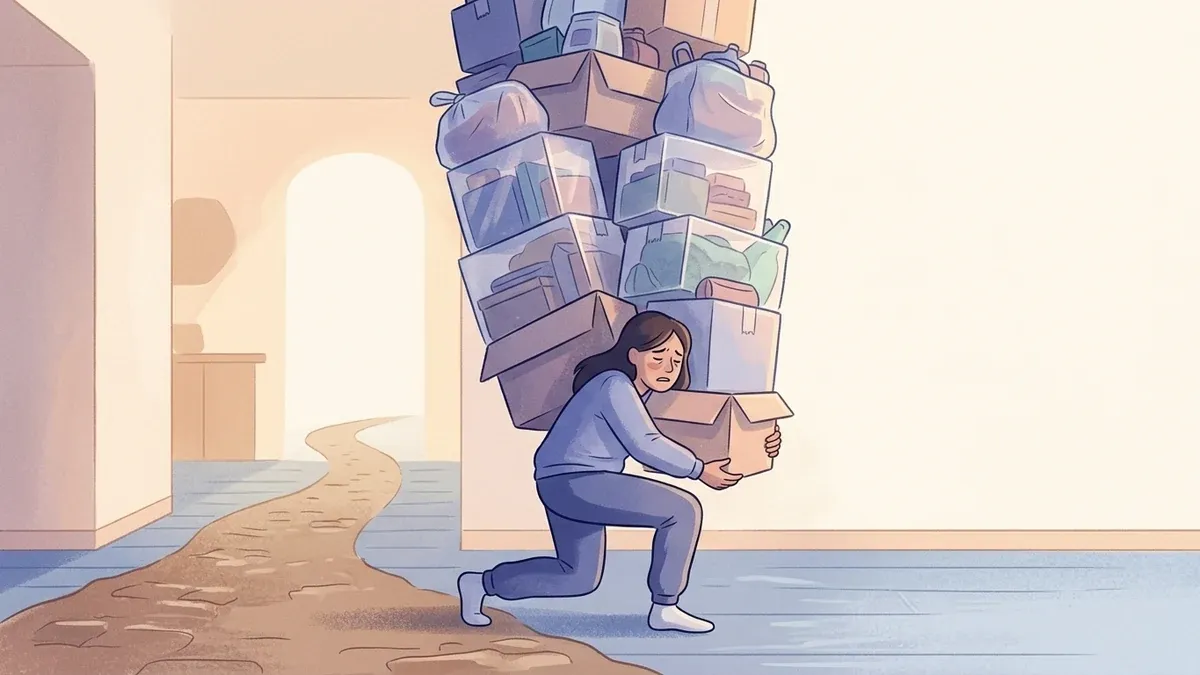
A woman walking slowly while carrying an enormous, teetering stack of boxes and bags piled far above her head, her knees buckling and body sinking into a low crouch under the weight, showing a nervous-system load that has stayed higher than capacity for too long until the body downshifts into a protective low-power mode.
When the load stays higher than what you can discharge for too long, the body downshifts to low-power mode to protect you. It can stay there after the pressure eases.

The shutdown can outlast what caused it. Once low-power mode becomes the default, it keeps running even after the pressure eases. That's why "just push through" rarely works: push-through is often what put you here. For the longer version, see our guide on how to get out of survival mode. And if you live with ADHD, the overlap is real: functional freeze and ADHD.

Freeze is a state your nervous system is holding, not a fact about who you are. States can shift, and that's what regulation slowly trains.
Tuun
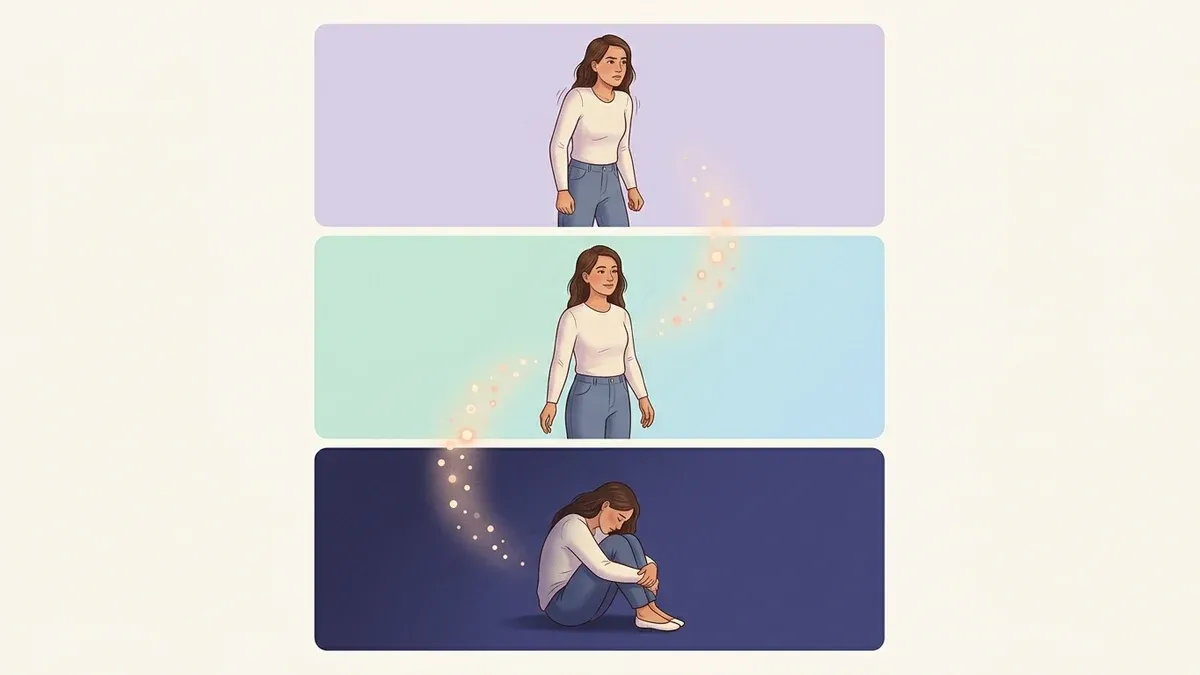
Three stacked bands showing the same woman in three nervous-system states: a pale alert band at the top where she stands tense, a calm mint-and-blue band in the middle where she stands settled, and a deep indigo band at the bottom where she sits curled and frozen, with a glowing trail of light rising from the frozen band up into the calm middle to show nervous system regulation moving the body out of freeze.
Your nervous system moves between states. Functional freeze is the low, shut-down one. Nervous system regulation is the practice of gently shifting back up toward the calm, settled middle.

How to get out of functional freeze

There's no single switch, but there is a direction, and it's the opposite of what productivity culture suggests. The way out is down, not harder. What tends to help:

  • Start smaller than feels reasonable. Not a thirty-minute routine, a sixty-second reset. Not "go for a run," but "stand up." A shut-down system accepts tiny inputs and rejects big ones.
  • Do it daily. The change is in the repetition. One small move every day for two months beats two hours of effort once a month.
  • Body first, then action. Functional freeze lives below language, so understanding it doesn't unfreeze you. A small physical shift comes first; the action lands more easily after.
  • Remove the decision. Deciding is the part that doesn't work in freeze. Having today's small move already chosen for you removes the obstacle.

A woman placing one foot onto the first of a path of low stepping stones that winds gently upward toward warm light, while a single oversized stepping stone floats faded and far out of reach ahead, illustrating that a tiny daily step is reachable when one big leap is not.
The way out is down, not harder. One small move you can reach today, repeated daily, beats the one big leap that stays out of reach.

This is the gap Tuun is built for: a daily card, five to seven minutes, calibrated to where you actually are. One small body-based move, one small action, designed for the days you can't start, so something still moves.

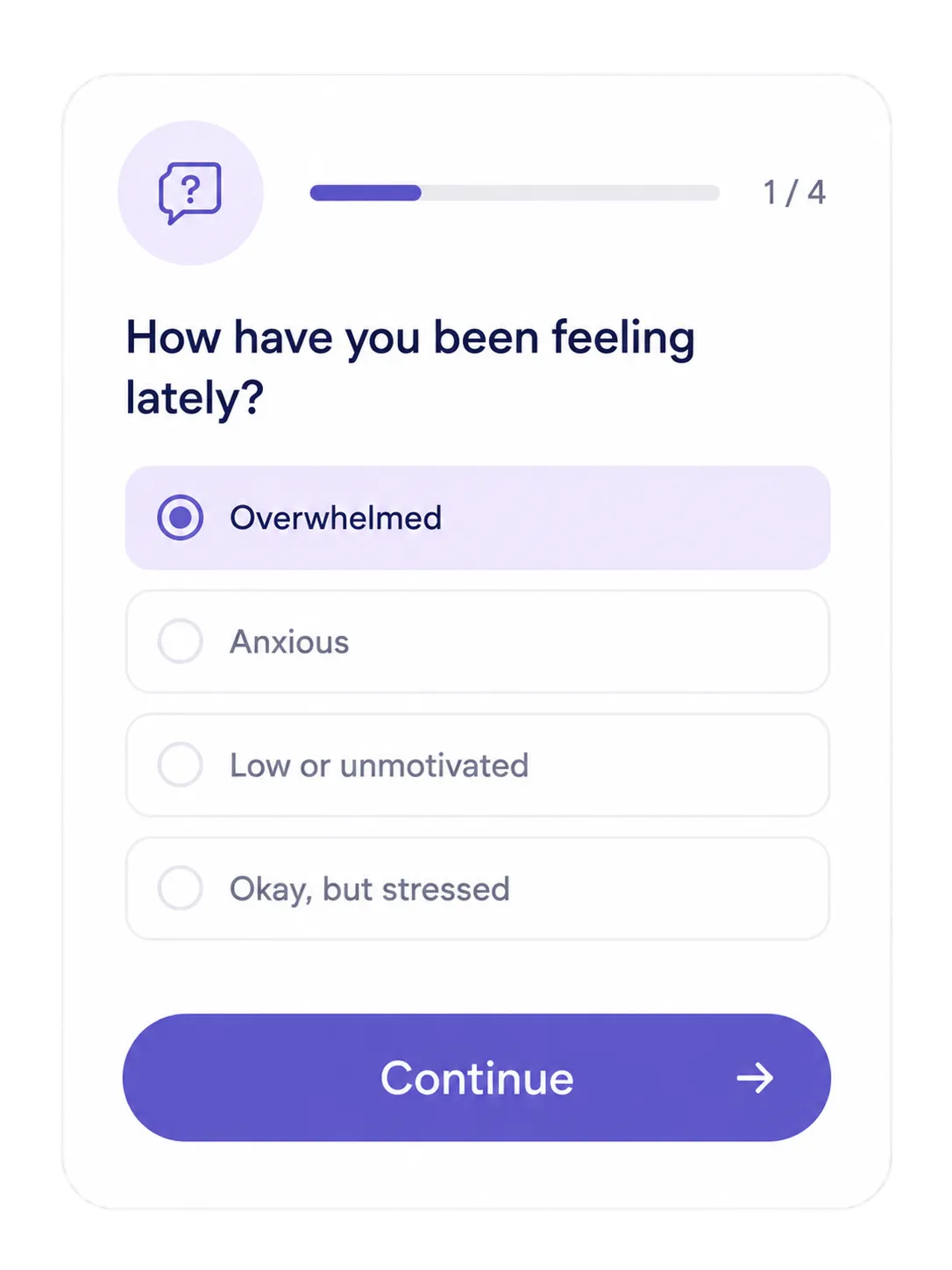
How it works

A simple three-step path to more personalized support.

  • STEP 1

    Take the quiz

    Answer a few questions about how you've been feeling, your patterns, and what kind of support would help most.

  • STEP 2

    Get your plan

    We turn your answers into a personalized path with daily cards, gentle tools, and guidance that fits real life.

  • STEP 3

    Start your daily reset

    Follow short daily sessions with check-ins, tools, and progress tracking that help you feel more grounded over time.

Expert-led

Backed by caring professionals

Therapists, coaches, and mental health professionals help shape the guidance, tools, and support inside Tuun.

  • Dr. Maya Bennett

    Clinical Psychologist

  • Kyle Ellis

    Somatic Practitioner

  • Clara Romero

    Licensed Therapist

  • 15+ professionals shaped the support inside Tuun

    A mix of therapists, coaches, and well-being experts helped us create a calmer, more thoughtful experience.

You've tried a lot

Here's how Tuun is different.

If you've spent real money and real time on the rest of this list and felt like none of it reached the layer where the freeze was actually living — that's not a coincidence.

Aspect
Other apps & tools
Tuun The difference
Day one
A default for everyone.
Built around you — from the first card.
Hard days
Stop working when you need them most.
Made for exactly those days.
Missing a day
Streak broken. Guilt. Start over.
Nothing breaks. It's built in.
After a month
More awareness, same body.
Lighter. Steadier. More you.

Tuun isn't a replacement for therapy or medical care. It's the layer underneath.

Loved by members

10,000+

people already meet themselves with Tuun.

  • I'd done years of therapy. I had language for everything. None of it touched the layer where the freeze was actually living. Tuun is the first thing that reached it.

    Hannah, NYC

    Trustpilot
  • Five minutes a day was the only format my brain could accept. Everything bigger collapsed. Tuun was designed for the version of me that couldn't start anything — and that version is the one who needed it.

    Sarah, Austin

    Trustpilot
  • I stopped calling myself lazy. That alone was worth the cost. Then the daily cards started working. I haven't missed an email in eleven weeks.

    Ali, London

    Trustpilot
  • I tried Calm, Headspace, Insight Timer, journaling apps, Notion. None of them worked because they all assumed I could already start. Tuun is the only one built for the days I can't.

    Maya, Toronto

    Trustpilot
  • Found this on TikTok at 2am after closing my laptop on an unsent email for the third time. Started day one the next morning. Eight weeks in and the unsent emails are getting sent.

    Priya, Brooklyn

    Trustpilot
  • Most apps make me feel worse for not using them. This one actually works WITH the days I can't. The companion is what got me to keep coming back.

    Jules, Portland

    Trustpilot
  • I look fine. I've always looked fine. This is the first thing that addresses the gap between how I look and how I actually feel.

    Kelsey, Chicago

    Trustpilot
  • Skeptical of every wellness app I've tried. This one earned the subscription. The 'I'm just lazy' lie I'd been telling myself was breaking me. Tuun gave me a different frame.

    Riya, DC

    Trustpilot

FAQ

Functional freeze, common questions

What is functional freeze?
Functional freeze is a low-grade nervous system shutdown where you keep functioning on the outside (work, texts, chores) but feel flat, stuck, and numb inside. It is a survival state, not a personality trait, and it can shift.
How do you get out of functional freeze?
You get out of functional freeze with small, daily, body-first steps, not big effort. Tiny inputs like a one-minute pause, standing up, or a single pre-chosen action are easier for a shut-down nervous system to accept. Consistency beats intensity.
What causes functional freeze?
Functional freeze is usually caused by chronic stress: when the load on your nervous system stays higher than your capacity for too long, your body shifts into a protective, low-power mode. Sustained pressure to perform and carrying more than you can discharge are common triggers.
Is functional freeze the same as depression?
Not exactly. Depression usually carries heaviness or sadness, while functional freeze feels more like flatness and numbness, like the lights are on a dimmer rather than out. If you are unsure or struggling, talk with a professional.
How long does functional freeze last?
There is no fixed timeline. Functional freeze can lift in weeks or quietly run for months or years because it hides behind being high-functioning. Steady, small daily input is what shifts it, not one big intervention.
Is functional freeze a sign of laziness?
No. Laziness is not wanting to do something; functional freeze is wanting to and being unable to make your body start. They look identical from the outside, which is why so many people in functional freeze blame themselves.
Is functional freeze real?
Yes. Functional freeze is a real, recognised expression of the body's freeze response, the same protective shutdown the nervous system uses under threat, just running quietly in the background of an otherwise functioning life. It is not a character flaw or an excuse, and naming it accurately is usually the first step to shifting it.

Start here

Your starting point is two minutes away.

The quiz finds your starting card. You don’t have to start anywhere bigger than the next five minutes.