
How to get out of survival mode (when you've been in it so long it feels normal)
Survival mode is your body stuck on a threat setting that never switched off. You get out in small, repeatable pieces, not by pushing harder.



On this page
The short version: survival mode is the state your body drops into when it’s been bracing for too long. Everything narrows down to getting through the day, and the things that aren’t strictly necessary quietly fall off the list. You don’t get out of it by force or by finally “sorting your life out.” You get out of it the way you got into it, gradually, by giving your system small, repeated signals that the emergency is over.
If that’s a relief to read, keep going. Most of what gets written about this assumes you can just decide to feel better. You can’t. That’s not a willpower failure. It’s the whole point of the state you’re in.
What does it mean to be stuck in survival mode?
Survival mode is when your nervous system has been on high alert, or in its quieter cousin, low-grade shutdown, for so long that the alert becomes the baseline. You stop noticing it the way you stop noticing a fridge hum. It just becomes the sound the room makes.
From the inside it usually feels like some mix of this:
- You’re getting through, but only the essentials. Work happens. Bills get paid, mostly. Everything optional, hobbies, friendships, the project you actually care about, has quietly gone dark.
- You’re tired in a way that sleep doesn’t touch.
- You feel braced, even on a calm Tuesday with nothing wrong. Your shoulders are up near your ears and you don’t know when they went there.
- Small things land too hard. A short text, a changed plan, an extra task, and you’re flooded, or you go flat.
- You can’t tell if you’re anxious or numb, because lately it’s been both, taking turns.
When people say they’re stuck in survival mode, this is usually what they mean: not a single bad week, but a setting that got left on. The body learned that bracing was the safest way to be, and then it kept bracing long after the thing it was bracing for ended.

Why can’t I just get out of survival mode?
Because the part of you that runs survival mode doesn’t take instructions from the part of you that reads articles like this one.
You can understand, completely and accurately, that you’re safe now, that the deadline passed, the relationship ended, the hard season is over, and your body can still keep running the program. Insight doesn’t switch it off. That’s why “just relax” has never once worked on you, and why the people who say it have never been in it.
There’s also a cruel loop built in: survival mode shrinks your capacity, and then the shrunken capacity becomes more evidence that something’s wrong with you. You can’t start the thing, so you call yourself lazy. You’re snappy or flat with the people you love, so you call yourself a bad partner, a bad friend. None of those labels are true. They’re just what the state looks like when you don’t have a name for it yet.
If you have spent years overriding your own limits to keep going, this short video names that pattern and where it leaves you. It is a gentle counter to the push-through reflex this article is about.
How do you actually get out of survival mode?
The way out is down and small, not up and big. Here’s what that means in practice.
Start lower than feels worth it. Your instinct will be to fix this with a big move: a reset week, a new routine, a clean-slate Monday. The system that’s in survival mode reads “big” as “more threat” and braces harder. So you go the other way. Not “go for a run.” Stand up and feel your feet on the floor for thirty seconds. Not “overhaul your evenings.” Put one hand on your chest and take three slower breaths out. These feel too small to matter. That’s exactly why they work: they’re small enough that your body will actually accept them.
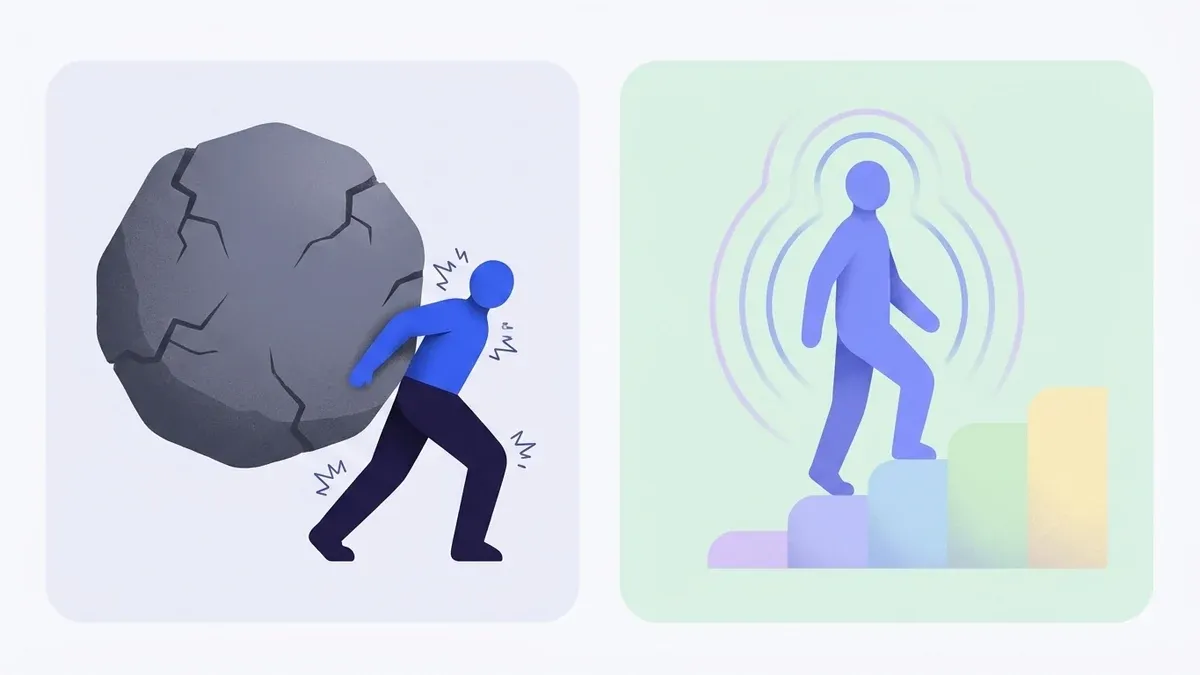
Tell your body the emergency is over, in a language it speaks. The nervous system doesn’t read; it reads signals. Slow exhales. Warmth. Weight: a hand, a blanket, your back against a wall. Something steady to look at. Unclenching your jaw on purpose. These small somatic exercises are mundane on purpose. You’re not trying to feel amazing. You’re trying to send one small “we’re okay” and let it land.
Regulation isn’t about doing less. It’s about building in the signals that tell your body it’s safe to recover.
Do it daily, not hard. One sixty-second move every day will move you further than two intense hours once a month, by a lot. The repetition is the medicine. You’re slowly teaching a braced system that calm is available and safe, and that only happens through small reps over time, the same way the bracing got learned in the first place.
Let “rest” count as productive. In survival mode, downshifting feels like falling behind. It isn’t. Coming out of this state is the work, even when it produces nothing you can point to.
Expect it to come back, and don’t read that as failure. You’ll have a regulated week and then a stressful day will drop you straight back in. That’s not a relapse. That’s a nervous system doing exactly what nervous systems do. The skill you’re building isn’t “never get dysregulated again.” It’s coming back faster each time.
How long does it take to come out of survival mode?
Longer than a weekend, shorter than forever, and not on a schedule you can force.
If you’ve been braced for years, you’re not going to undo it in a week, and any program that promises that is selling you the same push-through that wore you out in the first place. What you can expect, with small daily input, is that the floor slowly rises. The flat days get a little less flat. You notice your shoulders coming down. You catch yourself wanting to do something optional again, and that wanting, when it comes back, is one of the clearest signs the setting is finally changing.
That slow rise is what a real nervous system reset actually looks like, repetition over time rather than a single dramatic shift. This walk-through covers the same down-and-small approach if you would rather be guided through it.
If the survival-mode flatness sounds less like high alert and more like a quiet, performing-fine shutdown, looking capable on the outside while feeling switched off underneath, that has a more specific name, and it’s worth reading about functional freeze next.
A gentler place to start
You don’t have to figure out the whole way back today. You have to find the one small move your system can actually take right now, and then take it again tomorrow.
If you want help finding where to begin, the two-minute quiz reads where you actually are and builds a starting point from there, small enough that, even on a day nothing else moves, this one thing can. You can also keep reading on the blog if you’d rather sit with the ideas a while first.
You’ve been carrying this for a long time. The way out isn’t more carrying. It’s a hundred small signals that you can finally put some of it down.
Sources
- Karamalak, E.. (n.d.). Stuck in survival mode: how to regulate your nervous system. Stanford Lifestyle Medicine.
- The London Psychiatry Centre. (n.d.). Am I in survival mode? How to know and what to do about it. The London Psychiatry Centre.
- Jefferson Center for Mental Health. (n.d.). A how-to guide for surviving survival mode. Jefferson Center.
- Lyn, S.. (n.d.). You pushed through everything: 3 ways to get out of survival mode [Video]. YouTube.
- Kassam, S.. (n.d.). How to get out of survival mode (nervous system reset) [Video]. YouTube.
Tuun is a wellbeing product, not medical care. If you are in crisis, please contact 988 (US/Canada), Samaritans 116 123 (UK & IE), Lifeline 13 11 14 (AU), or your local emergency services. See our full wellness disclaimer.